
Refine, 03, THE HOUSE OF WORDS
Writer Companion
An idea, becoming your own
Find the words. Keep your voice.
Thoughtful support for the work of writing. Develop an idea while keeping the voice, choices, and authorship yours.
Status: In the studio
In the world
“I kept the crooked sentence. It sounded like me.”
- Make it leaner
- “I kept the crooked sentence. It was mine.”
- Make it more vivid
- “The sentence leaned a little. I let it. It sounded like me.”
- Keep the original
- “I kept the crooked sentence. It sounded like me.”
Overview
Where it started
Writer Companion began with one of our founders wanting to get better at the craft of writing. They didn’t want a model to write their prose. They wanted one to read what they had written, say where it faltered and suggest how it might improve, and leave the sentences to them.
That became the rule the product is built on: it will not write for you. The author decides what stays and what goes, voice matters more than polish, and the tool should teach, so that over time it is needed a little less.
Holding ourselves to it
A principle is only as good as the code that enforces it, so in July 2026 we audited the product against its own rules, with ten AI agents in three steps. One read the product documents and wrote down what the companion must never do, in terms specific enough to check in code. Eight read the code in parallel, one area each, citing a file, a line and a confidence rating for every finding. A last one drew the findings together. It was a reading of the code, not a user study, and the report says so.
The central promise held: no code path writes model output into a manuscript. The gaps were in memory and trust. A dismissed note came back on the next read-through. Analysis ran by itself two seconds after typing stopped. A finding seen by one model was reported with high confidence. A beta-reader quote that couldn’t be found in the manuscript was still shown as “From your text”.
The fixes followed as a series of pull requests: dismissals are remembered, the companion stays silent until asked, a lone juror is capped at medium confidence, and a quote that can’t be found is marked “Unverified”. One recommendation is still open: what keeps a note’s suggestion from becoming a rewrite is the prompt, not yet the code.
PRINCIPLES AT WORK
The problem
Most AI writing help works by rewriting. You hand over a paragraph and get back something smoother, blander and no longer yours. For a novelist, that trade costs the one thing the book can’t do without.
OUR APPROACH
Read a manuscript the way a trusted first reader would. Leave a few margin notes, say why a reader might stumble, and get out of the way. The companion never writes a word of the book.
What it does
- A read-through, when you ask for one: margin notes on structure, clarity, voice, rhythm and polish, each with its reason.
- Notes are drawn over the text, never written into it. You can jump to a note or keep your sentence as it is; there is no “apply” button.
- Remembers the notes you dismissed, so they don’t come back.
- Learns your voice from samples, and treats writing that sounds like you as something to keep.
- Adjusts for genre, so a romance is allowed its feeling and a noir its fragments.
- A Story Bible for characters, places, factions and the rules of your world, with suggested entries that show their evidence.
- A consistency check across chapters, run by one to three independent model “jurors”, the kind that notices grey eyes turning green three chapters later.
- A beta-reader report on pacing, character and theme, and a side-by-side comparison of two drafts.
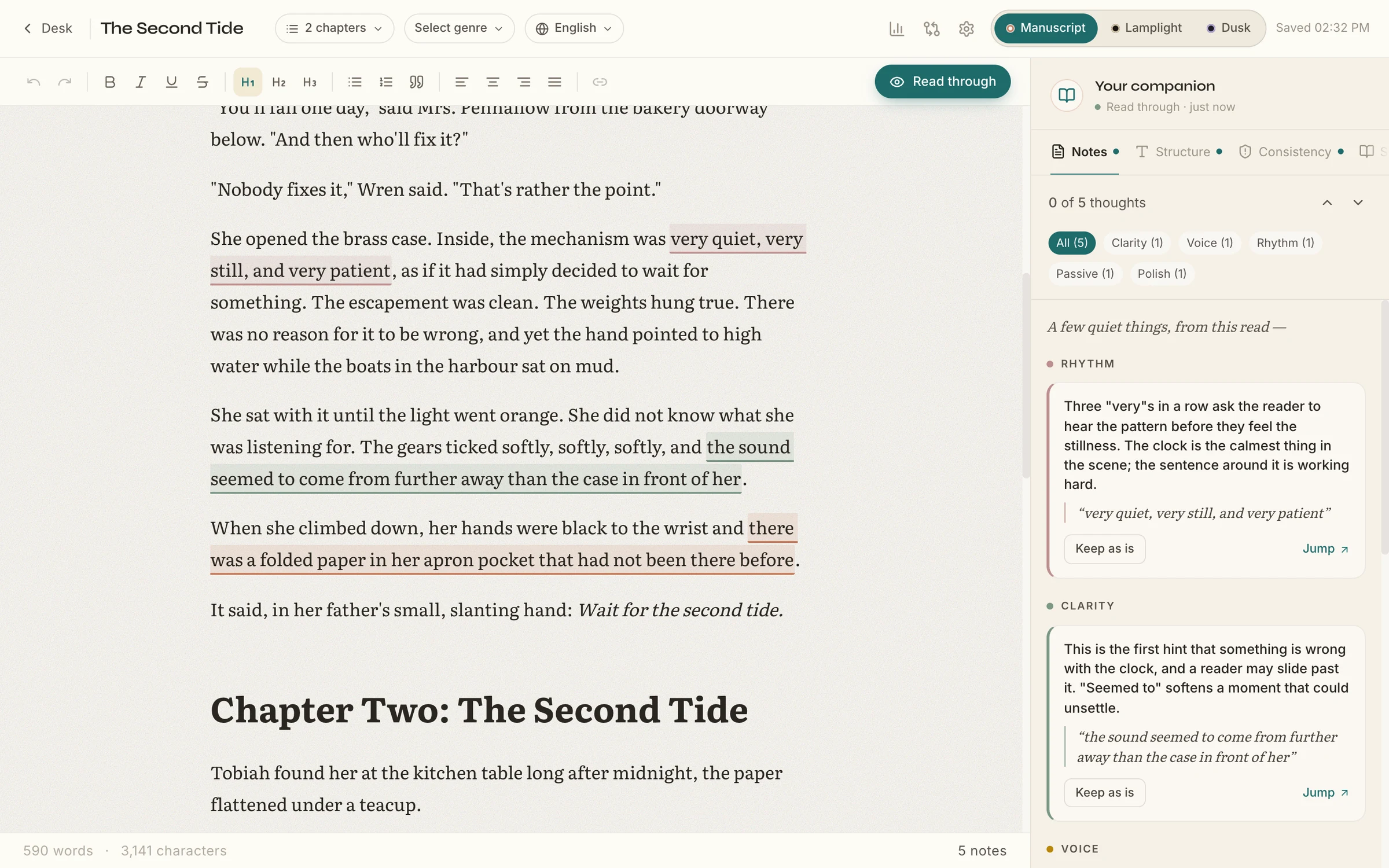
ScreenshotFictional dataRead through: notes sit in the margin, and the manuscript stays exactly as written. 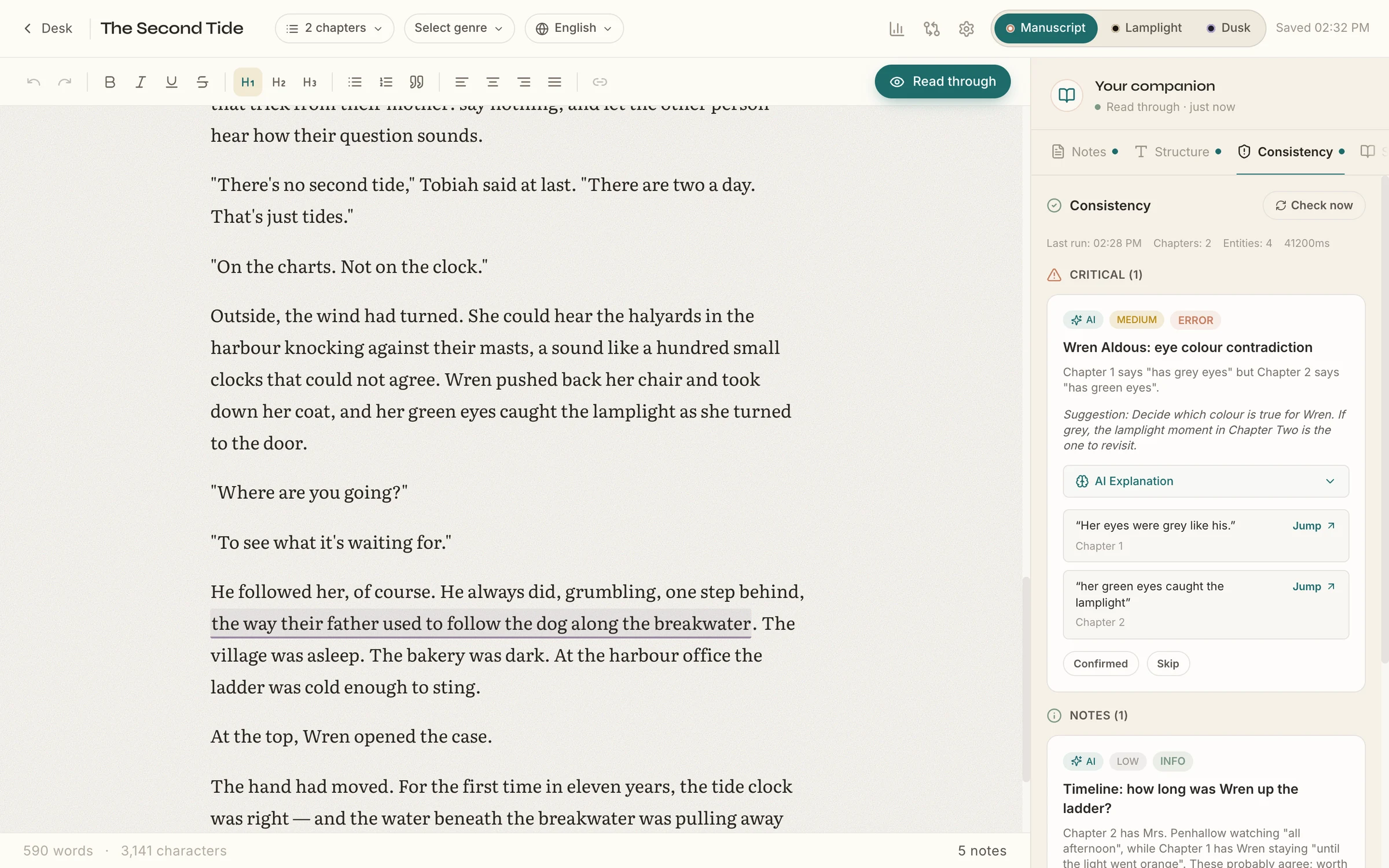
ScreenshotFictional dataThe consistency check catches a character's grey eyes turning green, and quotes both chapters. 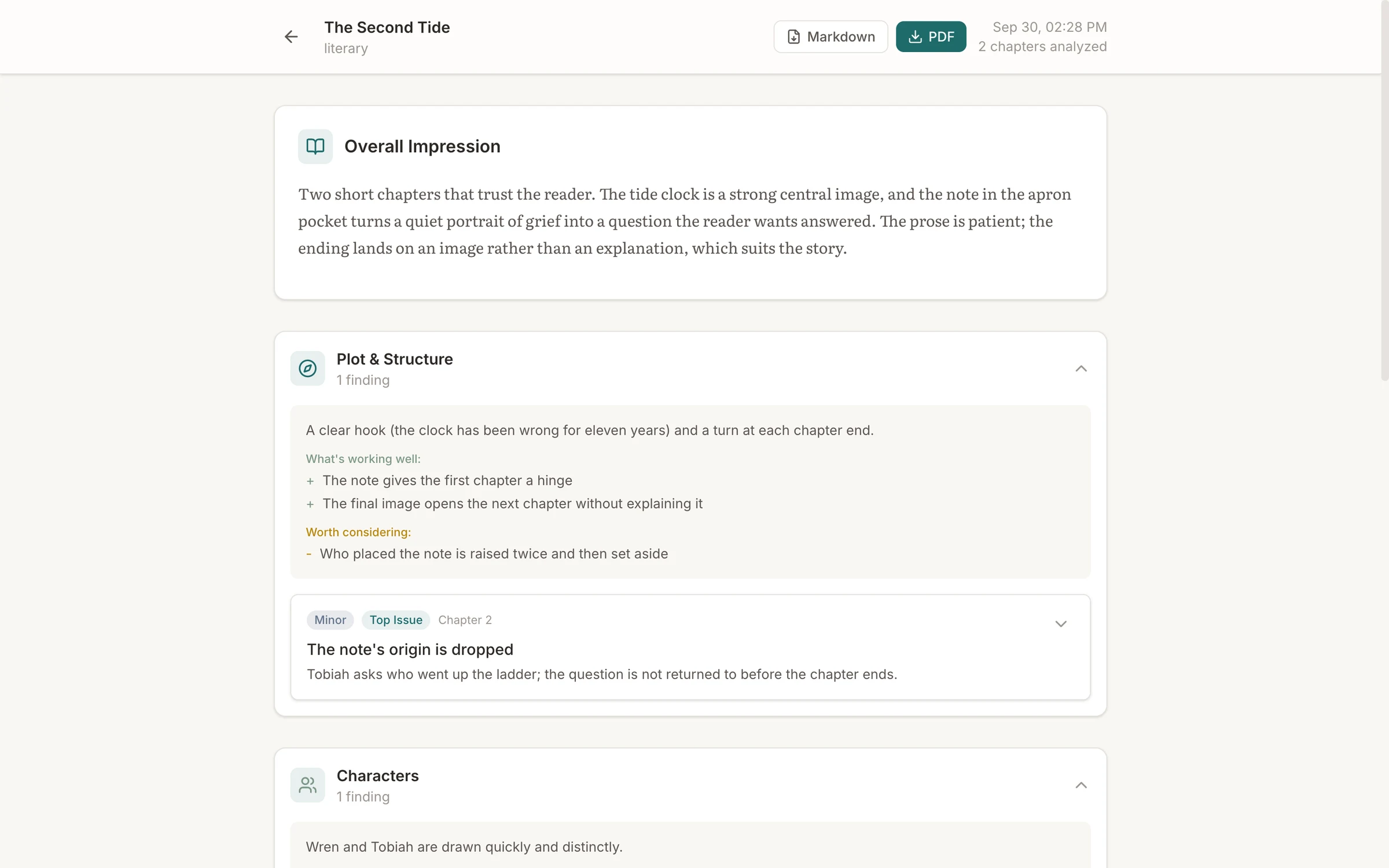
ScreenshotFictional dataBeta reader report: a narrative read, not a score, with findings anchored to the text. 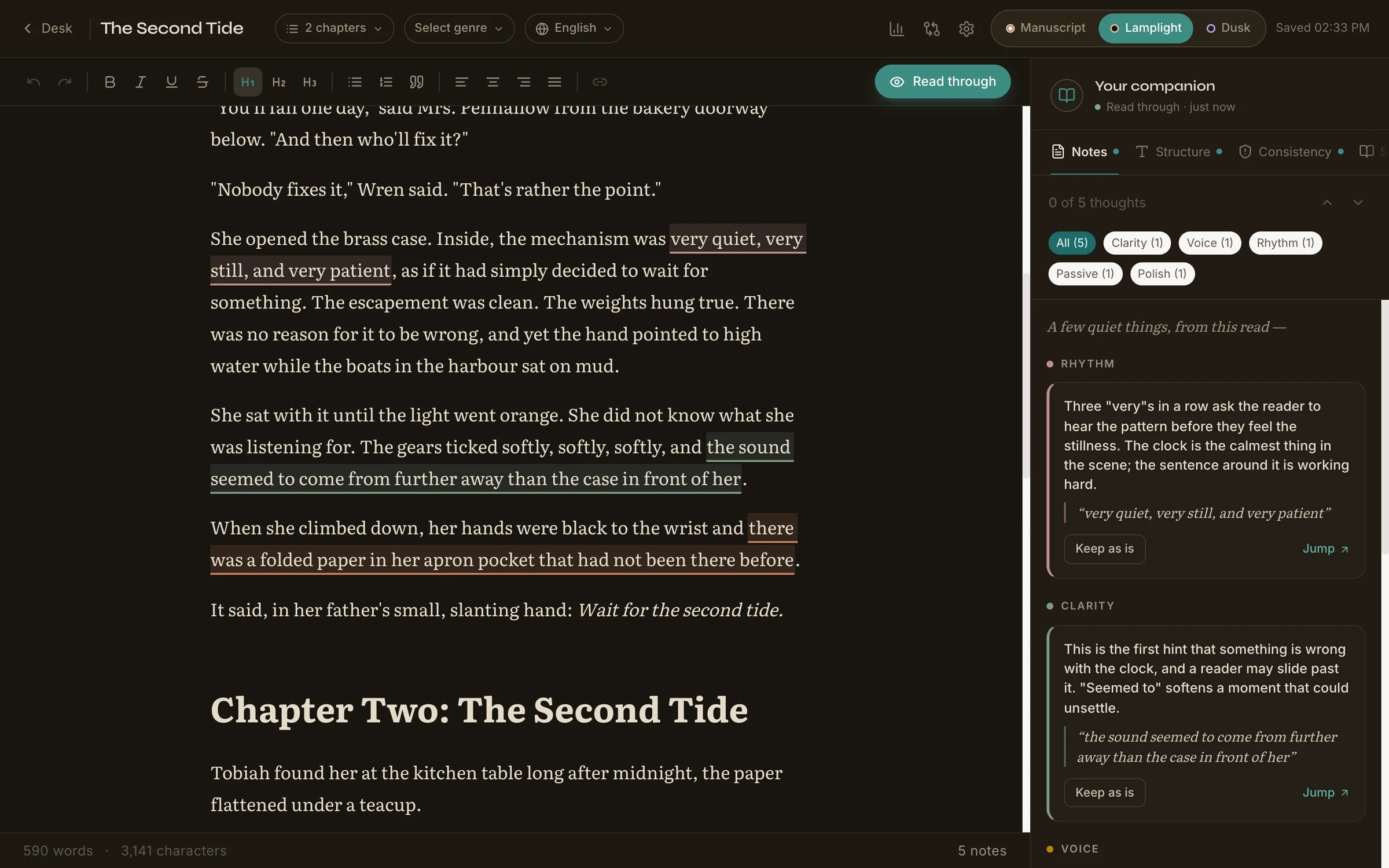
ScreenshotFictional dataLamplight, the evening theme.
How it’s built
- Next.js and React
- TipTap editor
- Postgres with pgvector, through Prisma
- Background jobs on Vercel
- Claude Sonnet 5 for read-throughs and most analysis, and Claude Opus 4.5 for the beta reader on the Standard and Deep presets
- GPT-5.2 or Gemini 2.0 Flash as alternative providers
- OpenAI text-embedding-3-small for semantic indexing
DECISIONS, AND WHY
Annotations, never edits
Analysis returns notes anchored to positions in the text, and the editor draws them as decorations. No code path writes model output into the manuscript. The promise is kept by the architecture, not only by a prompt.
Quotes must be found in your text
When a report quotes the manuscript, the quote is checked against the actual text. Anything that can’t be found is marked “Unverified” instead of “From your text”. Craft advice quotes curated passages by reference, so they can’t be invented.
Cost is part of the design
Fast, Standard and Deep presets set the model, effort and jury size, and every AI call is recorded in one ledger. In July 2026 a spend check found read-throughs were 96% of the app’s estimated AI spend to date: $44.66 over 998 runs, most of them within a minute of the last run on the same manuscript. Analysis now skips text it has already read.
Timeline
First commit.
The core in a few weeks: Story Bible, consistency checks, beta reader and budget guardrails.
Draft comparison, series and chapters, and background jobs rebuilt for serverless hosting.
A ten-agent audit of the product against its own principles, and the fixes it asked for.
“The Quiet Page” redesign, the move to Claude Sonnet 5 and a ledger for every AI call.
Status
Status: In the studioRefine. Express it more intentionally, in your own voice.
In the studio, and in progress. It runs privately, with new accounts approved by hand; there is no public release, page or waitlist yet.
Credits
- Product, design and engineering: one of the studio’s founders.