
Clarify, 02, THE LISTENING PAVILION
Arti
Every conversation leaves a trace
Hear what matters.
A place to make sense of conversations. Find the important ideas in what was said and the next steps worth carrying forward.
Status: In the studio
In the world
“Could we release on Friday?” “Only if the review is finished.” “Let’s decide tomorrow.”
- Find the thread
- Idea: a Friday release. Condition: the review must be complete. Decision: still open.
Overview
From side project to studio tool
Arti started as a side project to stop losing what gets said in working conversations. It had a different name then. Once it had earned a place in our own week, it became Arti, and it has stayed close to home since: a tool we use before it is a tool we sell.
Understanding, not just recall
A transcript is a record. It is not an understanding. The hard part is the second step: noticing that a condition was attached to a decision, or that a question was raised and never answered. Arti’s summary is written to catch those things, and to show its work. Every claim points back to where it was said, so you can listen and judge for yourself.
What we are still working on
Recording is capped at ninety minutes, and very long conversations are the next thing to make robust. The quieter work of the last year has gone into trust: editing, correction rules that carry across the archive, and a pipeline that fails slowly and visibly rather than losing a conversation.
PRINCIPLES AT WORK
The problem
What matters in a meeting, a call or an interview is said out loud and then lost. Notes are partial, the audio and the transcript live in different places, and the follow-ups slip.
OUR APPROACH
Keep the audio, the transcript and the understanding together, and write the conversation up the way a thoughtful colleague would: what it was really about, what was decided, what is still open, and who is doing what next.
What it does
- Records in the browser, keeping a phone awake through a long conversation and recovering a draft if the page closes, or takes an uploaded file.
- Transcribes with speaker labels, and lets you rename speakers and correct the text.
- Remembers correction rules and applies them across past transcripts, so a name misheard once is fixed everywhere.
- Writes an editorial summary: key points tagged as decisions, risks or open questions, action items with an owner, and the moments that mattered.
- Links every point back to its moment in the audio. Select it and the recording plays from there.
- Groups conversations into projects, with full-text search and a timeline.
- Looks across a whole project for themes, showing an estimate of the cost before it runs.
- Shares a conversation through a link that can expire, and supports workspaces with roles.
- Exports to text, Markdown and PDF.
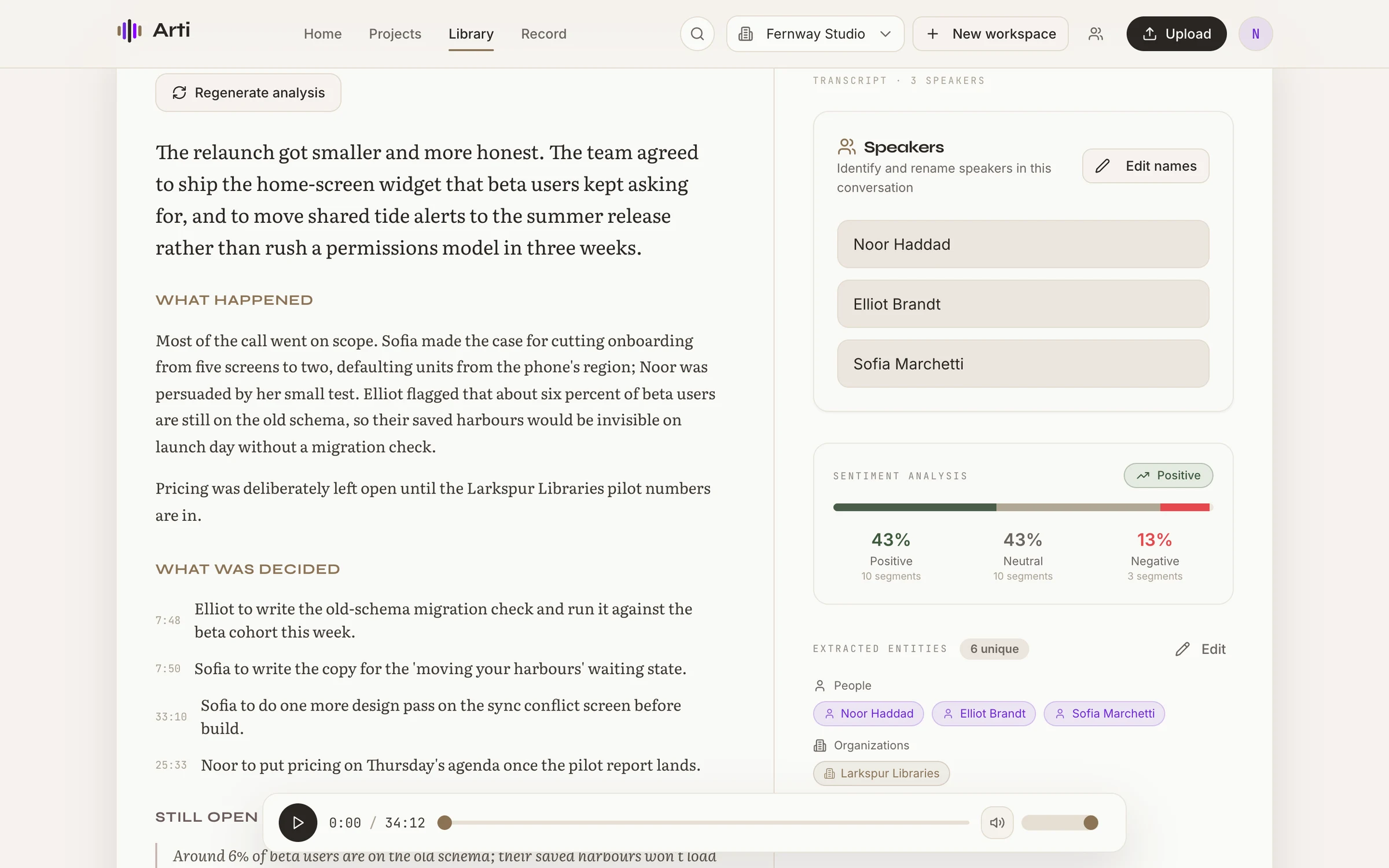
ScreenshotFictional dataA conversation, written up: the summary, what was decided and who owns what, with timestamps back to the audio. 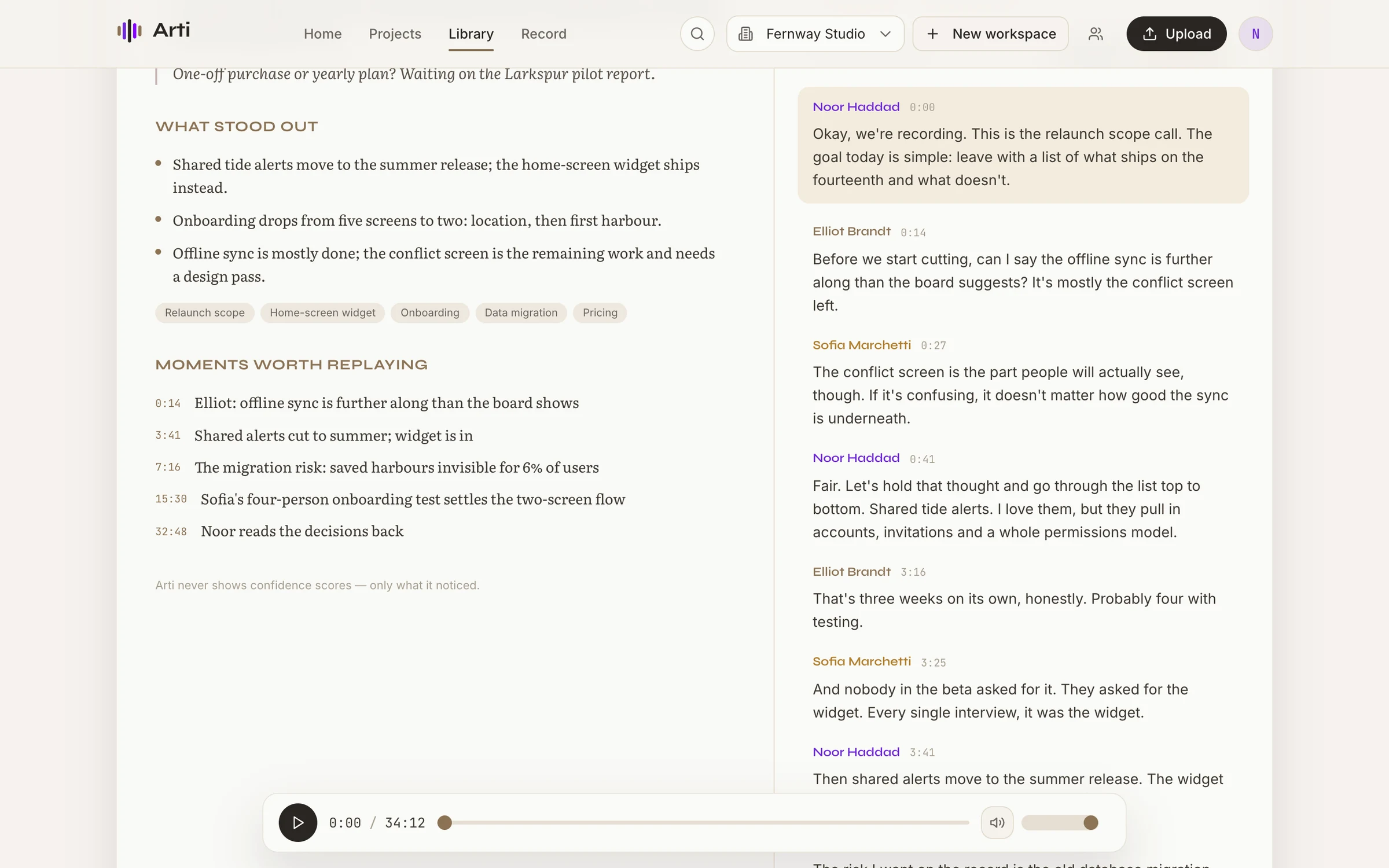
ScreenshotFictional dataMoments worth replaying beside the speaker-labelled transcript. 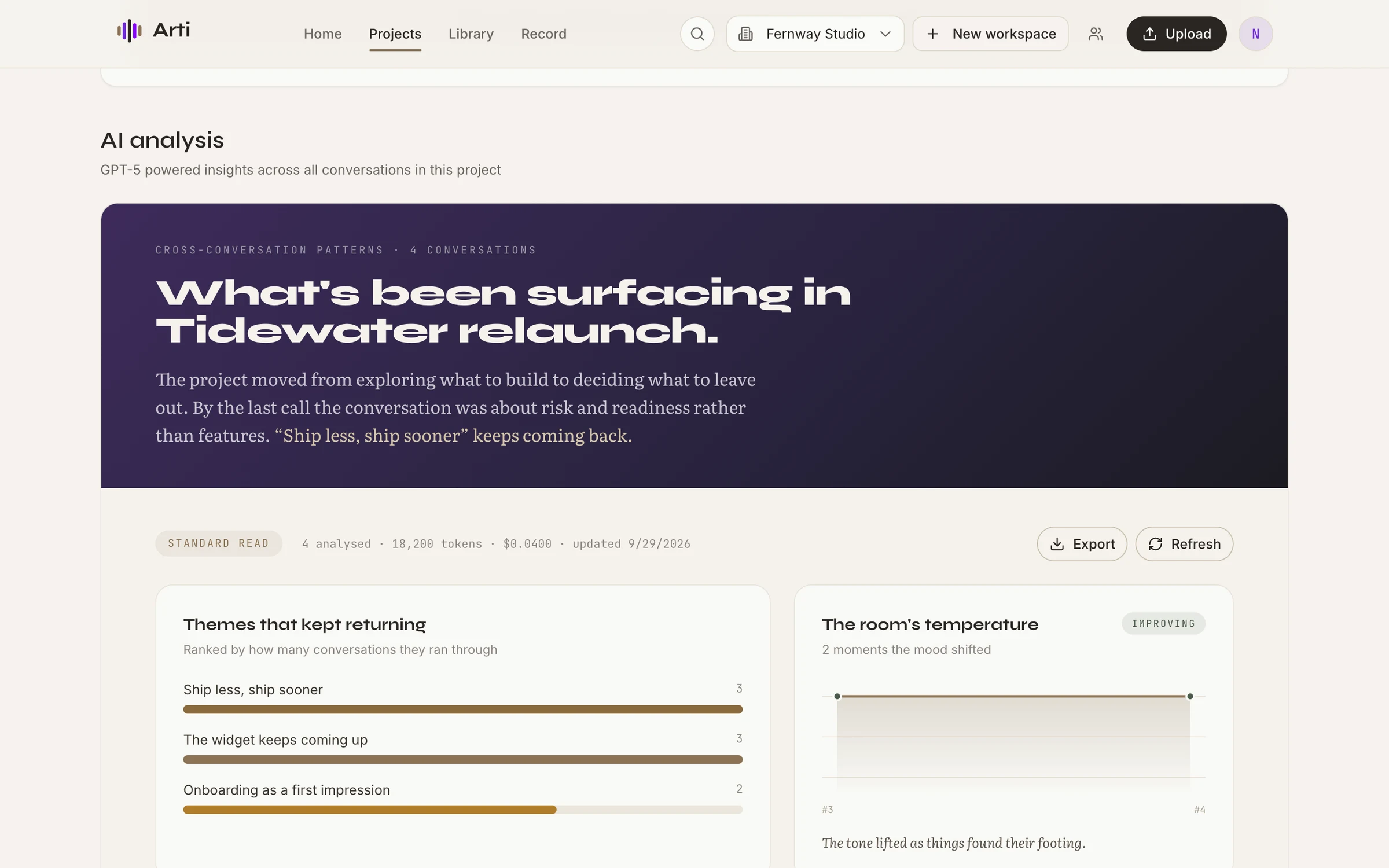
ScreenshotFictional dataProject analysis: the themes that keep coming back across a series of calls. 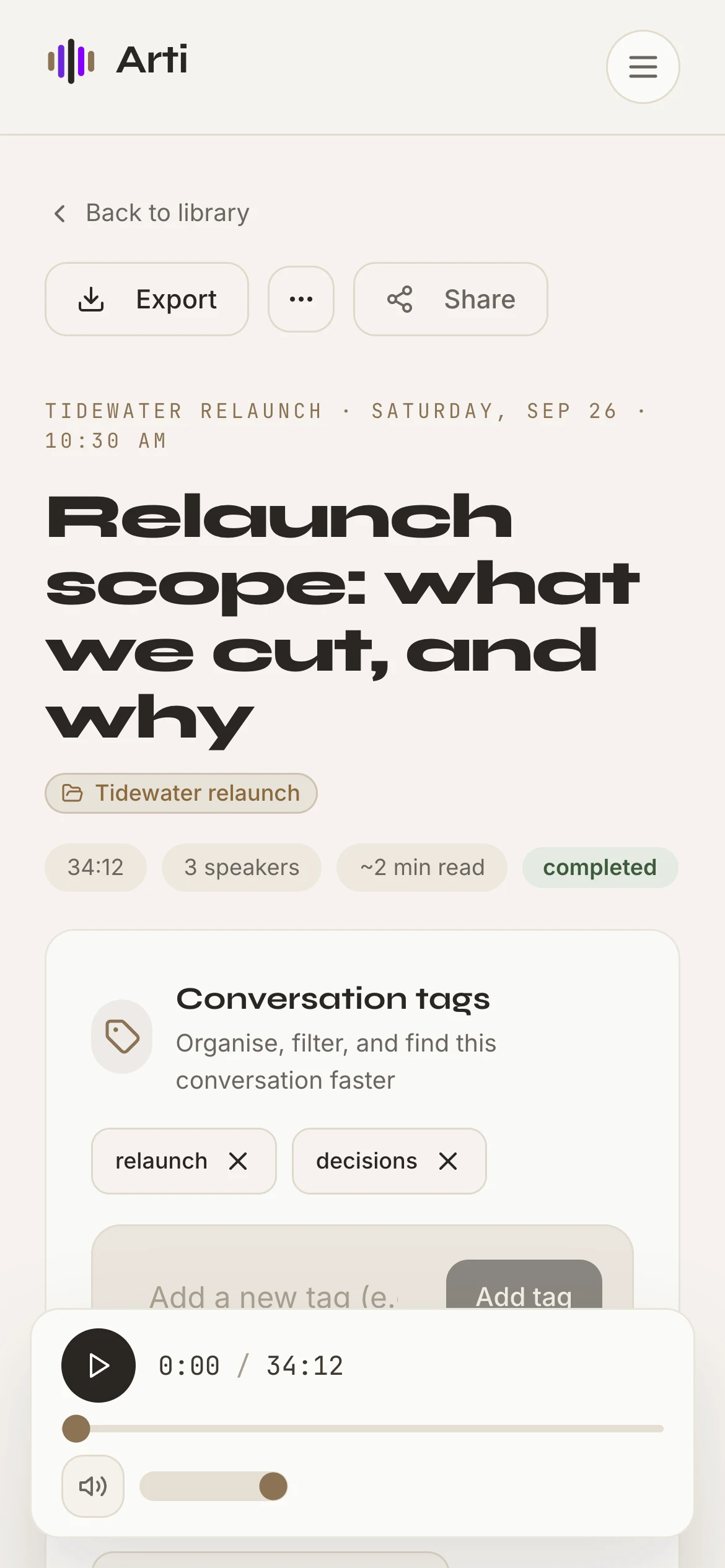
ScreenshotFictional dataThe same conversation on a phone.
How it’s built
- Next.js and React
- Tailwind and shadcn/ui
- Supabase (Postgres, auth, storage, row-level security, scheduled jobs)
- Speech-to-text from Deepgram Nova-3, with speaker labels, entities and sentiment
- OpenAI gpt-5, at medium reasoning effort for each conversation, and low, medium or high for a project by its depth
- Hosted on Vercel
DECISIONS, AND WHY
Heavy work happens in a queue, not a request
Uploads create a transcription job, which queues the analysis. A web request never waits on a model, so a slow conversation can’t hold up the interface.
One job at a time, on purpose
When overlapping background runs began to slow the database enough to sign people out, we rebuilt the processor around a lease lock: one job per run, with every timeout set below the platform’s limit. A slow transcription now waits and retries instead of disappearing.
Timestamps come from the transcript, not a guess
The model sees each line with its time and must carry that time into every point it writes. That is what makes a decision or an action item something you can click and hear.
Input is electric, output is editorial
The 2026 redesign keeps the recording screen dark and alive and sets the finished summary like considered writing on warm paper. The design lives in tokens, and its component kit is kept in sync with Claude Design using our own open-source tool.
Timeline
First version in a week: recording, transcription, analysis, projects, workspaces and share links.
Direct uploads to storage and an audio player tied to the transcript.
People, places and sentiment in transcripts, then a full audit, fixed tier by tier.
The job pipeline rebuilt for reliability, and the “Audio, considered” redesign.
Status
Status: In the studioClarify. Understand conversations, and the people in them.
In the studio, and in progress. We use Arti ourselves; there is no public release, page or waitlist yet.
Writing
Credits
- Product, design and engineering: one of the studio’s founders.