
Release, 01, THE REFLECTION GARDEN
Ponderare
A thought taking shape
A little space to hear yourself.
A voice-first journal for getting thoughts out of your head. Speak freely, then return to the patterns, questions, and ideas taking shape over time.
Status: Available now
In the world
“I miss making things with no deadline.”
- Release a thought
- “The good part happened after the meeting.”
- Release another thought
- “I don’t know what this is yet.”
- Release another thought
- Some thoughts find a thread. One can stay open. Not every thought needs an answer.
Overview
Where it started
Ponderare began as a habit, not a product. Each week we recorded talk-prep sessions with a colleague, then stitched the transcript, a model and the insights together by hand. It worked, and it was too many steps. What we wanted was one motion: record, submit, done.
A witness, not a therapist
Before most of the features existed, we wrote down how the app should speak: like a thoughtful friend who has been reading your journal. Curious, not prescriptive. Every observation it offers quotes your own words, points at a real moment, and ends with a question rather than a verdict. If there is nothing worth saying, it says nothing.
That rule shapes the product more than any feature. It is why The Mirror shows you a conversation you started and never came back to, not a mood score, and why a quiet week gets a short letter, not a streak warning.
Privacy first
A voice journal holds the most personal things people say, so privacy was the foundation rather than a setting. You can take every entry with you in open formats, and delete your account from inside the app.
The problem
Journaling apps are good at keeping entries and quiet about what is in them. And for people who think out loud, the blank page is its own obstacle.
OUR APPROACH
Make the first step a single motion: record, submit, done. Then let the app notice things slowly, as a witness rather than a therapist: quote your own words, ask instead of diagnose, and say nothing when there is nothing worth saying.
What it does
- Records a spoken entry and transcribes it, with a personal dictionary for the names and words you use.
- Lets you pause, scrub back through the waveform and keep talking. Recordings survive interruptions and a lost connection.
- Reflects on each entry gently, offering at most a couple of observations, and only when they clear a quality bar.
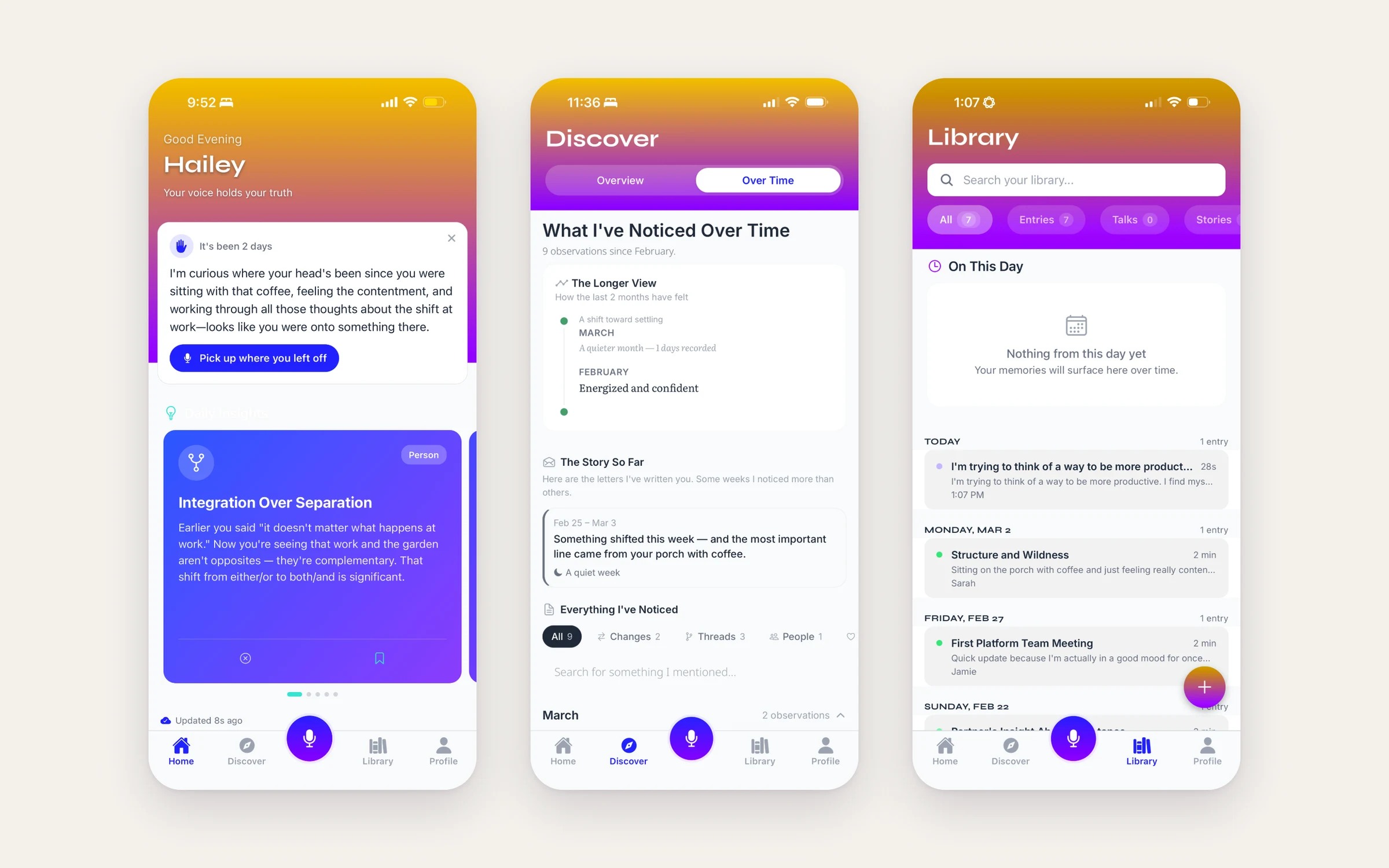
- Gathers the patterns in Discover: The Mirror, how things have felt, the people in your story, threads you might not see, and when things shifted.
- Notices what hasn’t appeared lately. That check runs on your phone, without a model.
- Writes a weekly letter, and a catch-up when you return after a few days away.
- Build-a-Talk: shape your own recordings into a spoken piece, with beats, takes and quotes found in your journal.
- Exports everything as JSON, Markdown or CSV.
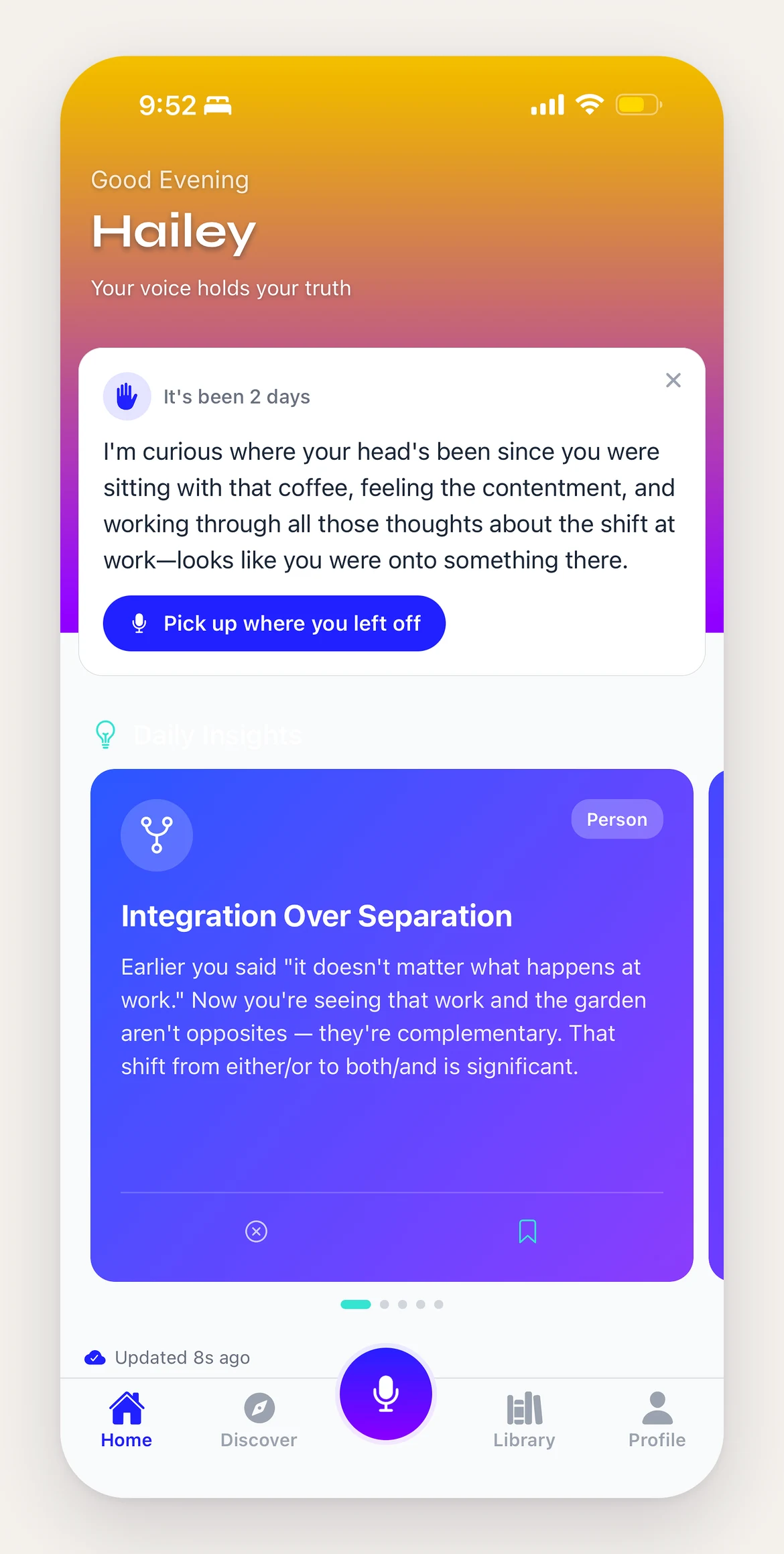
ScreenshotDemo accountHome: a gentle nudge and an insight that quotes your own words back to you. The demo account on ponderare.com.
How it’s built
- Expo and React Native (iOS and Android)
- Supabase (Postgres with row-level security, edge functions)
- A Rust gateway for every model call
- A small Go service for live voice
- Speech-to-text from Deepgram (Nova-3)
- OpenAI: gpt-5-nano, gpt-5-mini and gpt-5 for per-entry analysis, text-embedding-3-small for memory, gpt-realtime-mini for live voice
- Anthropic: Claude Sonnet 5 for longer, narrative work, such as The Mirror and journal chat
DECISIONS, AND WHY
One door for every model call
Every AI request goes through a single Rust gateway that handles sign-in, rate limits, per-person concurrency, caching and cost tracking. Spread across dozens of functions, rules like these get forgotten; in one place, they hold.
Send a model only what it needs
In October 2025 the gateway’s own measurements found a simple mood analysis sending 238,877 prompt tokens, because every call carried the whole conversation history. Keeping history only for the operations that use it brought that call to 249–293 tokens, a 99.88% reduction, and its cost from $0.012 to $0.00016 per request. Those are the gateway README’s figures for that one fix, not a general saving.
One voice for every prompt
A shared voice guide sits in front of every prompt that speaks to you. It asks for second person, quotes instead of paraphrase, tentative language, and never showing the machinery: no scores, no counts.
Insights are kept away from engagement numbers
Saves, dismissals and time spent are deliberately off limits when we tune what the app says. Optimizing for those would teach it to flatter, and a mirror that flatters is no use.
Features as contracts
Each AI feature is declared in configuration with a strict schema for its output, and CI fails if the code drifts from the declaration. It keeps a large surface honest as it changes.
Timeline
First commit. The app, the voice proxy and the gateway take shape.
Deeper insight work, including noticing contradictions between entries.
The North Star is written down: a mirror that shows you what you’re not looking at.
The Mirror and Discover redesign; first App Store submission, review feedback and resubmission.
Build-a-Talk, offline resilience and accessibility work.
Pause-and-review recording and cross-platform polish.
Status
Status: Available nowRelease. Say it out loud, and understand yourself.
Available worldwide on the App Store and Google Play, and still being refined.
Writing
Credits
- Product, design and engineering: one of the studio’s founders.
- A partner who gave Ponderare its identity, its business model and much of its polish.
- A colleague whose weekly talk-prep sessions were the first version of the idea.